
'Is renting cheaper?' is the wrong question
Hold an instrument long enough and the accumulated rental will always exceed the purchase price — that is the premise the rental business rests on, without exception. So the answer to 'is renting or buying cheaper' is decided entirely by how long you will hold it, and that is a question about how you plan to use it, not a financial question. What you should actually be asking is: in my situation, which month does the crossover fall in, and will my real period of use pass it?
What rental really sells is not a low unit price either, it is outsourced uncertainty. You do not know whether this project will be renewed, whether next year's test standard will be revised, whether this model is really right for your device under test — renting hands those uncertainties back to the supplier, at the cost of a higher total spend. Buying is the reverse: you exchange a one-off capital outlay for a low marginal cost over the long run, at the cost of holding every risk yourself from then on — obsolescence, failure, idleness, calibration and maintenance.
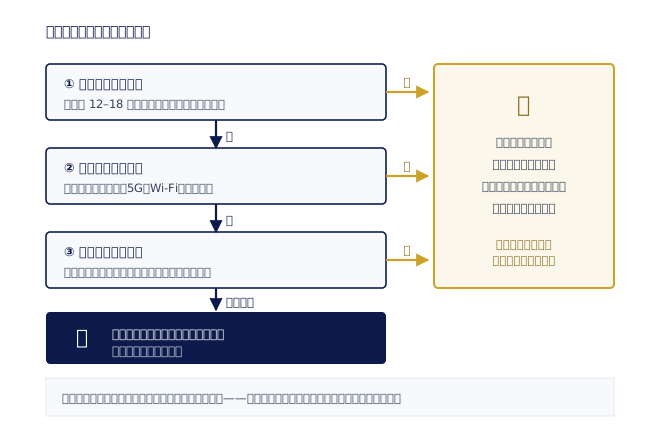
To state the conclusion up front, this article will not tell you to always rent: for a core instrument that is on the bench every day with a stable specification requirement, buying is almost always right. The value of rental is concentrated in a few situations — a short period, an unsettled specification, a constrained budget type, or the need to cover a gap temporarily. Work through the five questions below in order and the answer usually surfaces by itself; figure 1 draws that order as a decision tree.
One more route worth mentioning: used or factory-refurbished instruments. On models with stable specifications they can genuinely save a substantial amount, but three things must be settled before deciding — whether there is a traceable calibration record and repair history, whether the manufacturer still supports the model and stocks parts (modules for a discontinued model may no longer exist), and whether the software licences for the measurement options transfer with the machine. The third is the most common hidden cost in a used transaction: many option licences are tied to the serial number and are not necessarily transferable, and getting the machine without the licences means buying a platform that cannot make the measurement you bought it for. Once those three questions are answered, 'cheaper' turns into 'genuinely worth it'.
Question 1: How long do you really need it
Start by writing out every use you have for it over the next 24 months: how many weeks does each use need the instrument for? Add them up, divide by 24 months, and you have that instrument's utilization. Experience says that an instrument whose utilization stays below about 30% is hard to justify owning — most of the time it is depreciating in a cupboard, taking up space, and still has to go for calibration. Conversely, for a machine above about 70% utilization the rental will eat you alive.
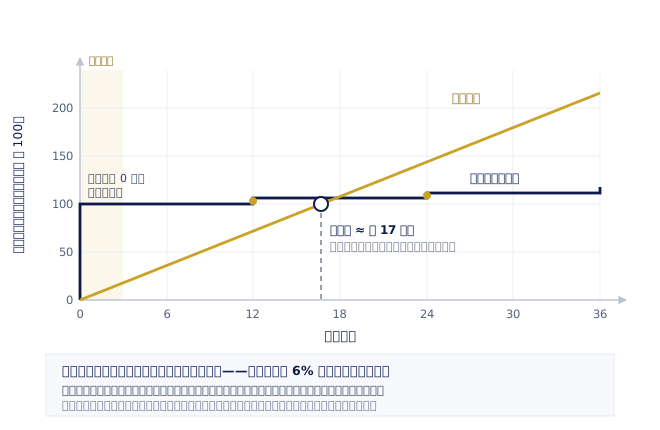
The crossover can be estimated yourself, and the arithmetic is simple: if the monthly rental is a fraction r of the purchase price, then accumulated rental catches up with the purchase price in roughly 1/r months. At r = 5% the crossover falls at month 20, at r = 8% it moves forward to month 12.5. Figure 2 illustrates it at r = 6%, where the crossover lands at month 17, and draws in the two annual steps by which the purchase line rises for calibration and maintenance. Two things to note: the ratio differs by model, by length of rental and by the options fitted — the monthly rate for a long rental is usually lower than for a short one, so the real figure has to be obtained when you ask for a quotation and cannot be assumed; and the purchase line is not horizontal, it climbs a little every year.
The structure of the rental period affects the answer too, and not only through price. The monthly rate for a short rental is usually higher than for a long one, so 'rent three months first and extend if necessary' and 'negotiate six months at once' can total up quite differently, which makes it worth asking for both scenarios when you request a quotation. More important is availability risk: a popular model is not on the shelf at all times, and whether an extension can be granted depends on whether someone else is queued behind that machine. If your project has a hard certification or test deadline this has to be confirmed in advance, rather than discovering at renewal time that you have to change machines — moving to a different model means the measurement scripts, the calibration artefacts and the comparison baseline may all have to be redone, and that engineering time is often worth far more than the difference in rent.
The most common misjudgement is underestimating the project. Queueing for certification, a firmware revision that forces a retest, a customer asking for one more mode to be measured — any of these can easily stretch a three-month project into eight, at which point the short rental that looked economical has crossed the crossover point. The other misjudgement runs the other way: buying because 'we are bound to need it eventually', then using it for 40 days in a year. The way to avoid both is the same — do not estimate by feel; write the uses down one by one and add them up, and multiply the project duration by a delay factor you privately know to be realistic.
Question 2: Will the next generation of standards overturn the specification you need
Some measurement requirements do not move for a decade: the voltage and current of a DC supply, basic timing and power-integrity measurements on an oscilloscope, distribution of a 10 MHz frequency reference, the 9 kHz to 30 MHz band for conducted EMI. Buy against requirements like these and what you have bought is an asset that will be in service a long time, with essentially no risk of obsolescence. For this class of instrument the purchase decision comes down to utilization and nothing else.
Other requirements are moving, and moving faster than the depreciation. Wireless communication standards are the classic example: going from 5G NR in sub-6 GHz to FR2 millimetre wave changes the upper frequency limit and the analysis bandwidth required by a whole class; going from Wi-Fi 6E to Wi-Fi 7 pushes the channel bandwidth to 320 MHz and the modulation to 4096QAM, tightening the EVM floor demanded of sources and analyzers and the phase noise requirement along with it. Committing capital mid-way through a standard's evolution to an instrument that is 'just good enough' amounts to betting long-term money on an assumption that will quite possibly be overturned within two years.
So the correct place for rental here is as a hedging instrument, not a way of saving money. The method is: rent one across a generation, make the real measurements while accumulating your own data on usage and required specifications, and once the requirement has settled and you know which options you actually need, decide whether to buy and in what configuration. This is also why 'rent first, buy later' is worth raising when you ask for a quotation — KanTek's rental page states explicitly that at the end of the term you can extend, return, or discuss converting to a purchase, with the details of a rent-to-own arrangement explained by sales at quotation time.
One angle is often missed: if your customer or your certification body specifies the grade of test equipment, then the decision about specification is not actually yours. In that case the flexibility to change machines as the requirement changes has value in itself.
Question 3: Capital expenditure, annual budget, and what three years of depreciation actually does
The same sum of money is a completely different thing on different ledgers. Buying is capital expenditure (CapEx): it goes through a purchase requisition, becomes a fixed asset, and is depreciated over several years according to the accounting policy. Rent is normally operating expenditure (OpEx): it comes out of the annual budget and is recognised in the period. The practical constraint on a small or medium Taiwanese company often shows up exactly here: this year's capital allocation is used up, and the project cannot wait — at which point 'renting is more expensive' is true, and 'renting is the only way to have the instrument within the deadline' is also true.
The specific depreciation period depends on accounting policy and tax rules and should be confirmed with your finance department rather than copied from someone else's figures. But one thing is independent of the period and worth understanding on the engineering side: depreciation merely spreads the cost across years on the ledger, while the cash goes out once, in month zero. The purchase line in figure 2 jumping vertically to full height at time zero is drawing exactly that. For an organisation sensitive to cash flow, that vertical jump is itself a cost, and rental converts it into a line with a gentle slope.
Residual value deserves an honest look too. After three years the instrument still has book value and there is still a second-hand market, but residual value only equals usable value while the specification is still fit for purpose. For an analyzer superseded by the next generation of standards, book residual and real usefulness to you can be very far apart. Conversely, for models with stable specifications — oscilloscopes, power supplies, frequency standards — residual value holds up well and the financial risk of buying is correspondingly low. Which loops back to question 2.
Question 4: Beyond the list price, what is the total cost of ownership
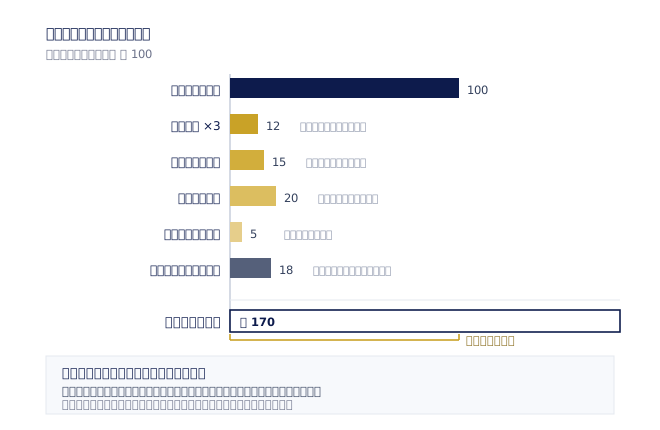
The most common error when comparing renting with buying is setting the monthly rental against the purchase list price. That comparison does not hold from the outset, because the list price is only part of the cost of ownership. Figure 3 breaks three years of ownership into its parts in relative units: beyond the purchase price there is annual traceable calibration, repair and extended warranty once the warranty has expired, software licences for measurement options, storage, handling and stocktaking, and engineering labour. Added together, three-year total cost of ownership frequently reaches 1.5 times the purchase price or more, with the list price accounting for about 60% of it.
Taking them one at a time, the item that cannot be cut is calibration. As soon as your measurement results have to go into a report, or be accepted by a customer or an auditor, you need calibration traceable to national standards, and you need it annually — that cost and the downtime while the instrument is away recur every year. Next is the repair risk once the warranty expires: the cost of replacing a module in a high-end RF instrument can be a considerable fraction of the purchase price, and what an extended warranty does is convert that uncertain risk into a fixed, certain outlay; whether that is worth it depends on your tolerance for downtime.
The single item most often left out of the sum altogether is the software licences for measurement options. The chassis of a modern instrument is only a platform; the work is done by the options — 5G NR and Wi-Fi demodulation analysis, EMI measurement, phase noise, serial bus decoding — and those licences frequently cost as much as the chassis. Budgeting for the chassis without budgeting for the options ends with the instrument on the bench and the measurement you wanted still impossible; in practice this is the most expensive omission of all.
Last come two items that barely ever appear on a quotation and are nonetheless real: space and people. Rack space, handling, stocktaking, scheduling calibration, coordinating repairs all take someone's time; more importantly, an engineer needs time before they are really fluent with a new instrument, have written good automation scripts and established the measurement procedure. Those engineering hours do not disappear, they simply are not on the purchase order. Rental folds some of them — arranging calibration, repair, custody — into the rent and hands them to the supplier; buying leaves all of them in your annual budget and your headcount. There is no general rule about which is cheaper, but both sides have to be measured with the same ruler.
In fairness, rental has hidden costs of its own; do not count only the ownership side. There are at least five to settle before signing: how an extension at the end of the term is priced and whether the slot is held; the criteria for the equipment condition check on return, and who judges what counts as 'not user-inflicted damage'; the amount of any deposit and the conditions for its return; whether the accessories are complete (test cables, calibration kits, probes and adapters often have to be listed separately, and one missing item means no measurement); and the engineering time spent revalidating the measurement setup every time the machine changes. None of these appear in the monthly rental figure, and all of them exist. Add them in and the comparison between renting and buying is finally like for like — which is also why, when you ask for a quotation, you should describe the whole situation and let the other side quote against these conditions too, rather than asking only what it costs per month.
Question 5: How peaks get absorbed, and what KanTek actually provides
The first four questions deal with the steady state; the fifth deals with peaks, and peaks are what buying cannot solve. There are three typical situations: a certification or test deadline approaching while your own instrument is still tied up on the production line; a quarter of unexpected volume with not enough test stations; your own instrument failing and going in for repair with the line unable to stop. Buying a second unit for these peaks means buying an asset with very low annual utilization, and once the peak is over it still has to be calibrated and stored. Renting one for a short period to cover the gap is almost always the more sensible choice in all three. It is also why KanTek's repair service states explicitly that a replacement unit can be arranged for the duration of a repair — renting and buying are not opposites here, they are complements.
The five questions collapse into one sentence: if the period of use will pass the crossover, the specification requirement is stable, the budget can go through as capital expenditure, and the instrument will be on the bench every day — buy. If any one of those does not hold, rent for a while first, especially when you are not yet sure which one you should be buying. Figure 1 is that order drawn as a decision tree.
As for what KanTek Technology itself provides, here it is, so that you can factor the scope of service into the decision. KanTek is the authorized Taiwan distributor for Rohde & Schwarz and Pendulum Instruments, providing instrument sales, instrument rental (launching soon), equipment repair, equipment calibration, operator training, and custom test system integration. Calibration is traceable calibration through accredited partner laboratories, in line with TAF / ISO/IEC 17025, delivered with the calibration report and certificate; the repair service covers genuine parts and module replacement and coordination of factory returns, with a replacement unit that can be arranged for the repair period; training covers both online and in-person courses and can be tailored to requirements.
The status of the rental service should be stated plainly: it is launching soon. Advance enquiries are open at this stage; it is not yet an online rental you can order from immediately. The planned rental categories are oscilloscopes, spectrum analyzers, signal generators, vector network analyzers (VNA) and EMC test equipment, with power meters, DC power supplies and frequency counters listed as categories to be added. Rental periods will be arranged flexibly by model and availability, with short projects typically counted in weeks and long-term use planned in months or years; equipment is function-checked before dispatch, and if your report needs calibration traceability, say so when you enquire and a unit with a valid calibration record will be provided. Measurement options, calibration kits and test cables can be requested together, with the available combination confirmed against stock; technical advice and fault handling are provided during the rental period, and at the end of the term you can extend, return, or discuss converting to a purchase. Rental price bands are not published on the site — the package and the quotation are provided at enquiry time according to model, period and options, so please ask directly rather than substituting a figure from some other source.
If you have read this far and are still unsure, there is one decision method that costs the least: get the instrument in your hands on a short rental and make the measurement you actually need to make. What one real measurement tells you is usually more reliable than three more data sheets — and it answers questions one through four at the same time.