
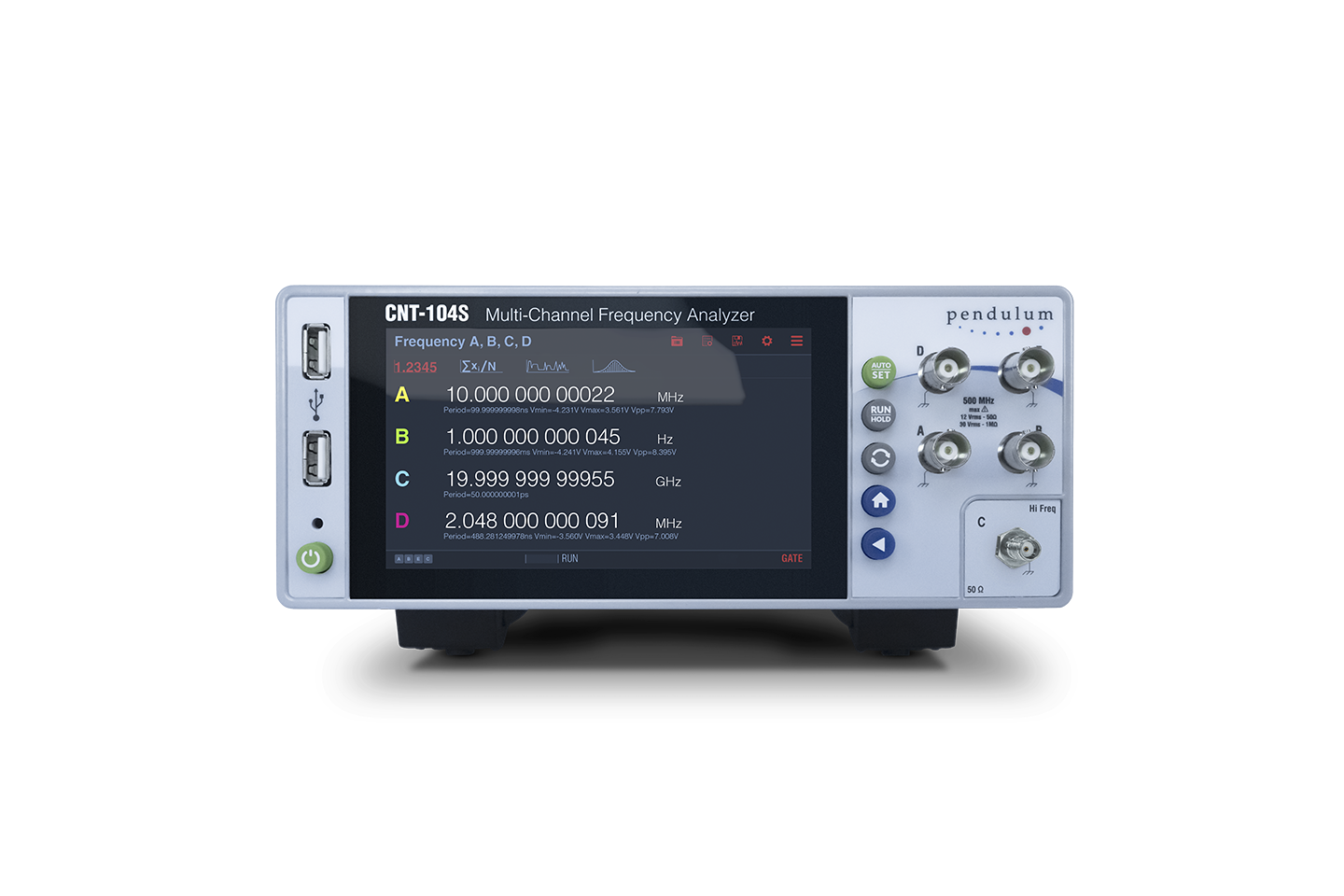
CNT-104R
Multi-channel Rubidium Frequency Calibrator / Analyzer
- Category: Multi-channel Rubidium Frequency Calibrator / Analyzer
- Manufacturer: Pendulum Instruments
- Measurement channels: 4 channels (A, B, D, E; optional C as the RF channel)
- Standard input frequency range: DC to 400 MHz
- Optional RF input frequency range: Extends to 24 GHz (optional RF input module)
- Time resolution: <7 ps
- Data sheet: Download PDF
- External link: Official product page
Overview
The CNT-104R is Pendulum Instruments' flagship four-channel rubidium frequency calibrator/analyzer for metrology, released in December 2024. An ultra-stable 10 MHz rubidium reference oscillator is built in, and four input signals can be timestamped in parallel with no dead time at all, gap-free, at 12 to 13 digits/s frequency resolution and better than 7 ps time resolution. The standard input frequency range reaches 400 MHz, extending to 24 GHz with the optional RF input module for microwave work. With optional GNSS control (Option 55) the rubidium clock stays locked to UTC, reaching a frequency accuracy of 1x10⁻¹² averaged over 24 hours and a time calibration uncertainty below 10 ns rms — so one CNT-104R replaces four traditional counters plus a rubidium frequency standard, cutting both laboratory equipment cost and bench space. The large graphic display can show numeric values, statistics, frequency distribution and the trend over time in four views at once, and a Gigabit Ethernet interface with web remote access is built in for easy integration into an automated measurement system.
Key features
- Rubidium frequency standard built in — An ultra-stable 10 MHz rubidium oscillator inside the instrument, with a very low frequency ageing rate; add optional GNSS control and it stays traceable to UTC at an accuracy of 1x10⁻¹² averaged over 24 hours, with no external frequency standard needed.
- Four channels, synchronous and gap-free — Four independent input channels timestamp four oscillators or clocks at once with no dead time at all, at up to 20M measurements per second, which lifts calibration throughput substantially.
- Ultra-high-resolution frequency and time analysis — Better than 7 ps time resolution and 12 to 13 digits/s frequency resolution, with gate time continuously settable from 50 ns to 1000 s, covering frequency, period, time interval error (TIE), pulse width and rise/fall time measurement.
- Optional 24 GHz RF input — The standard input range reaches 400 MHz; the optional RF input module (channel C, 2.92 mm connector) extends measurement to 24 GHz for frequency calibration and analysis in the microwave and satellite bands.
- Large graphic display and remote access — A large built-in graphic screen shows numeric values, statistical distribution, a frequency histogram and the trend over time in four views at once; Gigabit Ethernet and a web interface are standard, for remote monitoring and SCPI automation.
- One box in place of five instruments — A single CNT-104R replaces four traditional counters and a rubidium frequency standard, saving rack space and purchase cost; the housing works both on the bench and as a portable, so it moves between laboratory, factory and field.
Typical applications
- Calibrating several oscillators in parallel — Metrology laboratories and in-house calibration departments can measure four oscillators or frequency sources in parallel against the built-in rubidium frequency reference (accurate to 1x10⁻¹² averaged over 24 hours with the GNSS option). One CNT-104R takes the place of four traditional frequency counters plus a separate frequency reference, which shortens the calibration cycle and lowers equipment cost.
- Frequency characterization of communications and navigation systems — Testing radios, radar and navigation equipment, aerospace and defence manufacturers use the CNT-104R's modulation domain analysis (MDA) to capture transient frequency changes in a pulsed RF signal at better than 7 ps time resolution. It also serves as a portable travelling clock, verifying a synchronized clock on site away from the laboratory and free of any fixed GNSS installation.
- Verifying traceability of 5G and telecoms synchronization clocks — Telecoms equipment makers and network synchronization engineers use the CNT-104R to assess the frequency stability and drift of GSM, 4G LTE and 5G base station clocks. GNSS disciplining brings measurement uncertainty to 10 ns rms against UTC, which keeps a synchronization clock within telecoms traceability standards such as ITU-T G.8272.
Key specifications
Key specifications for CNT-104R, as published by Pendulum Instruments. For the full datasheet or a customized configuration, please get in touch.
| Measurement channels | 4 channels (A, B, D, E; optional C as the RF channel) |
|---|---|
| Standard input frequency range | DC to 400 MHz |
| Optional RF input frequency range | Extends to 24 GHz (optional RF input module) |
| Time resolution | <7 ps |
| Frequency resolution | 12 to 13 digits/s |
| Gate time range | 50 ns to 1000 s (variable) |
| Maximum measurement rate | 20M measurements/s (4 channels in parallel); fast block measurements to 170k/s |
| Internal memory | Up to 32M samples |
| Reference oscillator | Built-in 10 MHz rubidium oscillator |
| Frequency calibration accuracy | <1x10⁻¹¹ (standard); 1x10⁻¹² (24 h average, with the optional GNSS module) |
| Time calibration uncertainty | <10 ns rms to UTC (with the optional GNSS module) |
| Input impedance | 1 MΩ or 50 Ω (selectable) |
| Input connectors | Main inputs A/B/D/E: BNC; RF input C: 2.92 mm (SMA compatible) |
| Power supply | 100 to 240 VAC, 50 to 60 Hz (±10% tolerance) |
| Operating temperature | 0°C to +50°C, 5% to 75% relative humidity |
| Storage temperature | -40°C to +71°C |
Frequently asked questions
Need CNT-104R Multi-channel Rubidium Frequency Calibrator/Analyzer pricing, rental or calibration?